
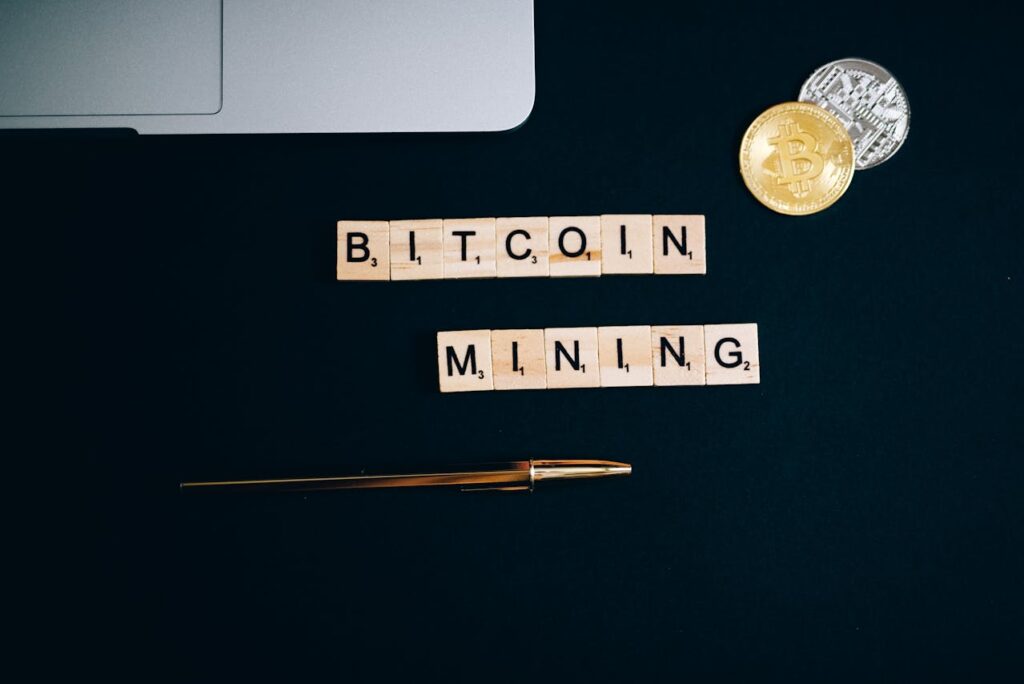
Mining Bitcoin is the process of validating transactions and adding them to Bitcoin’s public ledger (the blockchain) while earning new BTC as a reward. Over the past decade mining has evolved from hobbyist activity (CPU/GPU) into a professional industry dominated by specialized hardware (ASICs), large mining farms, and mining pools. This guide explains what mining is, the methods available, the required hardware and software, step-by-step setup, economic considerations, and best practices.
What Is Bitcoin Mining?
At a technical level, Bitcoin uses a proof-of-work system (SHA-256). Miners gather unconfirmed transactions into blocks and race to solve a cryptographic puzzle: find a nonce that makes the block header hash lower than the current target. The first miner to find a valid solution broadcasts the block; if accepted, the miner receives the block reward (new BTC + fees). The network adjusts difficulty every 2016 blocks to keep average block time ≈ 10 minutes.
Mining Methods
- ASIC Mining
Application-Specific Integrated Circuits (ASICs) are purpose-built devices for SHA-256 mining. They offer the best hash rate per watt and are the industry standard today. - GPU Mining
Graphics cards (GPUs) were once common for mining many coins. For Bitcoin (SHA-256), GPUs are inefficient versus ASICs, so GPUs are mostly used for altcoins. - CPU Mining
Central processors are now far too slow for Bitcoin mining and are not practical. - Cloud Mining
You rent hashing power from a provider. This removes hardware management but can be risky due to contracts, fees, and scams.
What You Need to Mine Bitcoin
- Hardware—An ASIC miner (examples: Bitmain Antminer, MicroBT WhatsMiner) or a reputable cloud-mining contract.
- Power Supply—Reliable PSU sized for your miner(s); stable electrical infrastructure and cabling rated for loads.
- Internet Connection—A stable, always-on connection (low bandwidth, low latency required).
- Cooling & Ventilation—ASICs generate significant heat; fans, airflow planning, or immersion cooling are essential.
- Bitcoin Wallet—A secure address to receive mining payouts (hardware wallet recommended for large balances).
- Mining Software—Firmware for the ASIC (often preinstalled) or mining clients for pool connections (cgminer and bfgminer for older hardware; many ASICs use web UI).
- Pool Account (optional but common)—Mining pools aggregate hashpower and distribute rewards proportionally; examples include F2Pool, Poolin, AntPool, and SlushPool.
Step-by-Step Mining Setup
- Choose Hardware:Select an ASIC based on hash rate (TH/s) and energy efficiency (Joules/TH). Balance upfront cost vs. expected returns.
- Secure Power & Cooling: Calculate electrical draw (W) and ensure your circuit, breakers, and wiring can handle continuous operation. Provide airflow or cooling solutions.
- Prepare a Wallet:Create or configure a Bitcoin wallet address to receive rewards. Use a hardware wallet for long-term storage.
- Pick a Mining Pool:For most miners, join a reputable pool to receive steady payouts. Check payout schemes (PPS, PPLNS), fees, and reliability.
- Configure Miner: Connect the miner to the network, access its web interface, and set the pool URL, worker name, and wallet payout address.
- Monitor & Maintenance: Use the miner’s dashboard and third-party monitoring tools to watch hashrate, temperatures, fan speeds, and uptime. Perform firmware updates carefully.
Profitability & Economics
Mining profitability depends on:
- Current BTC price
- Network difficulty and total network hashrate
- Your miner’s hash rate and power consumption
- Electricity cost per kWh
- Pool fees and hardware depreciation
Use mining calculators (enter TH/s, power, and electricity cost) to estimate earnings. Remember difficulty increases and BTC price volatility affect returns—expect long payback periods for expensive gear if electricity is expensive.
Legal, Regulatory, and & Environmental Considerations
Check local regulations: some jurisdictions tax mining income, require business registration, or restrict energy use. Environmental concerns center on energy consumption; many miners seek renewable energy or waste-heat reuse or operate where power is cheaper and cleaner.
Security & Best Practices
- Keep your wallet’s private keys and seed phrases offline and secure.
- Change default passwords on miner web UIs and restrict access (VPN or firewall rules).
- Monitor for firmware vulnerabilities and install trusted updates.
- Plan redundancy for power outages (UPS) if uptime is critical.
- Record serial numbers, warranties, and proof of purchase for hardware support.
Common Pitfalls & Alternatives
- High Electricity Costs:Mining is rarely profitable with expensive retail electricity rates.
- Hardware Shortages and & Price Volatility:ASIC prices and availability fluctuate—buying used gear carries risk.
- Scams in Cloud Mining:Many cloud-mining offers are low quality or fraudulent—vet providers thoroughly.
If direct mining isn’t suitable, alternatives include buying BTC, staking other PoS coins, or investing in mining stocks and ETFs.
Bitcoin mining remains a technically and economically involved activity. Success requires careful hardware selection, efficient operations (power and cooling), security hygiene, and ongoing cost analysis. For hobbyists, small rigs can be educational; for serious operators, competitive margins depend largely on energy cost and scale. Always do thorough research, run realistic profitability models, and consider regulatory and environmental impacts before investing in mining infrastructure.