
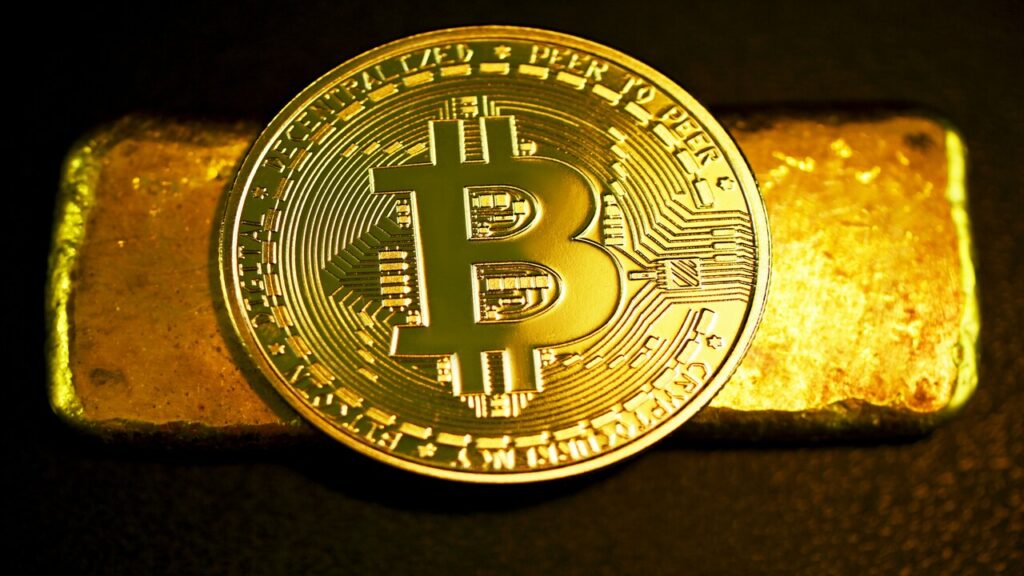
The question of whether Bitcoin will replace gold as the world’s primary store of value is one of the most debated topics in finance and crypto circles. Both assets are often compared because they share certain characteristics—scarcity, portability, and use as an inflation hedge—but they differ in important ways: history, volatility, regulatory treatment, and underlying technology. This article examines the arguments on both sides and considers realistic scenarios for coexistence or substitution.
Similarities Between Bitcoin and Gold
- Scarcity: Gold is finite by nature; Bitcoin is scarce by design (capped supply of 21 million BTC).
- Store of Value Narrative: Both are positioned as hedges against inflation, currency debasement, and geopolitical risk.
- Non-sovereign asset:Neither asset depends on a single government for valuation (though both are affected by policy).
- Portfolio Diversification: Investors hold both for diversification and to reduce correlation with traditional financial assets.
Key Differences
- History’s & Cultural Role:
Gold has been a store of value for millennia, with deep cultural, industrial, and monetary roles. Bitcoin is less than two decades old and still establishing its long-term narrative.
- Liquidity & Market Structure:
Gold markets are large, liquid, and supported by physical markets, ETFs, central bank reserves, and industrial demand. Bitcoin liquidity has grown rapidly with ETFs, futures, spot markets, and institutional custody, but it remains smaller in absolute dollar terms than global gold markets.
- Physical vs. Digital:
Gold is a tangible asset with industrial uses; Bitcoin is purely digital and depends on digital infrastructure and cryptography.
- Regulation & Custody:
Gold custody and trading are well established and regulated. Cryptocurrency regulation is evolving, and custody models (self-custody, institutional custodians) are still maturing.
- Portability & Divisibility:
Bitcoin excels in portability and divisibility—tiny fractions can be transferred globally in minutes. Gold is bulky and costly to move in large quantities.
Volatility:
Bitcoin’s price has historically been much more volatile than gold. High volatility makes Bitcoin less suitable as a short-term safe haven, though volatility has trended down as markets mature.
Arguments That Bitcoin Could Replace Gold
- Superior portability and divisibility: A digital native asset that’s easy to transfer and split.
- Programmatic scarcity:Clear supply cap and predictable issuance make Bitcoin’s scarcity auditable in ways gold isn’t.
- Growing institutional adoption: ETFs, custody services, corporate treasuries, and sovereign interest increase legitimacy.
- Technological advantages: transparent ledger, cryptographic security, and composability within digital finance ecosystems.
- Younger generations: Preference for digital assets could shift long-term demand away from physical stores like gold.
Arguments That Gold Will Endure
- Time-tested trust: Gold’s history as a money and wealth reserve spans centuries and cultures.
- Intrinsic industrial demand:Jewelry and industrial uses provide a baseline demand absent for Bitcoin.
- Lower volatility: Gold is less speculative and perceived as a safer haven during crises.
- Regulatory clarity and sovereign reserves:Central banks hold gold as a strategic reserve—a political and economic anchor that’s hard to displace quickly.
- Risk of technology/regulatory failure:Bitcoin depends on digital infrastructure and favorable regulation; adverse rulings or systemic tech issues could limit adoption.
Hybrid & Coexistence Scenarios
Rather than outright replacement, a more plausible near- to medium-term outcome is coexistence with shifting roles:
- Complementary stores of value: Institutions and individuals could hold both assets—gold for long-term, stable reserves and Bitcoin for digital-native exposure and potential asymmetric upside.
- Segmented demand: Emerging-market tech adopters and digital-first investors may favor Bitcoin, while conservative institutions and central banks retain gold.
- Partial substitution: Some allocation may flow from gold to Bitcoin as portfolios modernize—impacting price discovery for both assets without full replacement.
Barriers to Full Replacement
- Scale: The total market value of above-ground gold is enormous; Bitcoin would need tremendous new capital to match that scale.
- Regulatory risk: Governments may limit Bitcoin’s use, custody, or institutional adoption for financial stability or monetary policy reasons.
- Trust & permanence: Long-term confidence in Bitcoin’s immutability and governance must be earned and preserved.
- Environmental & energy debates: Perceptions (and realities) around energy use can influence adoption and policy—though technological evolution can mitigate impacts.
What Would Accelerate Bitcoin Replacing Gold?
- Broader institutional acceptance (central banks, sovereign wealth funds).
- Regulatory frameworks that enable safe institutional custody and clear legal status.
- Lower volatility through deeper, more liquid markets and a diversified participant base.
- Technological improvements that make Bitcoin more energy-efficient or otherwise reduce externalities.
What Would Prevent It?
- Severe regulatory clampdowns or fragmented international rules.
- Major security incidents or loss of faith in custodial systems.
- Persistent, structural volatility that keeps conservative buyers away.
- Continued central bank preference for gold as a geopolitical reserve asset.
Will Bitcoin replace gold? It’s possible in certain theoretical futures, but unlikely to happen overnight. A more realistic near- to medium-term outcome is coexistence with rebalanced portfolios: Bitcoin gaining market share as a digital store of value while gold retains a significant role driven by history, industrial demand, and central bank reserves. The long-term trajectory will depend on regulation, institutional adoption, technological resilience, and the evolving preferences of investors worldwide.